
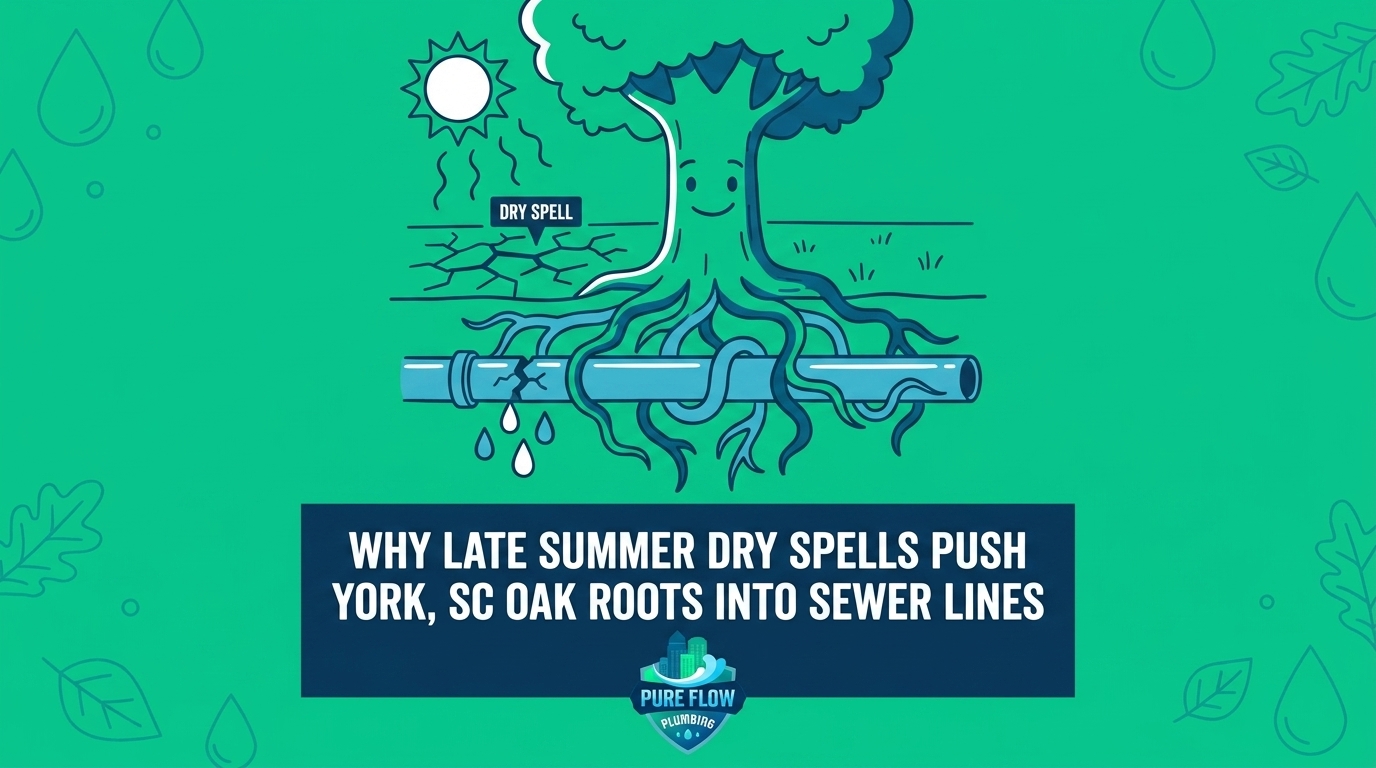
The Hidden Cause of Sudden Late-Summer Plumbing Emergencies
Your drains are backing up, the ground-floor toilet is gurgling every time you run the sink, and you are left wondering what went wrong when there hasn’t been a drop of rain in weeks. Understanding exactly how late summer dry spells push York oak roots into sewer lines is the key to solving this frustrating mystery. Most homeowners don’t realize that the weather above ground directly dictates the health and security of the plumbing below ground. When the intense August heat in York bakes the South Carolina soil, it creates a severe soil moisture deficit that forces mature vegetation to seek hydration wherever it can find it.
If you are dealing with sudden systemic backups, our sewer repair services and advanced sewer camera inspection can pinpoint the exact cause without the guesswork.
During an extended late summer dry spell, mature tree roots—particularly those of massive, established oaks—become the primary culprits behind sudden plumbing emergencies. These root systems are highly adaptive survival networks. When natural rainfall disappears, they do not simply stop growing; they change direction. They begin hunting for alternative water sources, and your home’s underground wastewater pipes often become their primary target.
The underlying mechanics of this problem include:
- Severe soil dehydration: The August heat strips the upper layers of soil of all available moisture, forcing roots to dive deeper.
- Vapor detection: Roots possess an incredible ability to sense condensation and moisture vapor escaping from microscopic imperfections in underground pipes.
- Unrelenting pressure: Once a water source is located, the roots exert immense physical pressure to breach the pipe and access the nutrient-rich water inside.
Because this entire battle happens several feet underground, diagnosing it requires specialized equipment to see inside the pipe. Guessing at the cause of a dry-weather backup often leads to wasted time and recurring frustration.
Understanding Hydrotropism: Why Oak Roots Target Underground Pipes
To understand why your plumbing is under attack during a drought, you have to understand a biological process called hydrotropism. Hydrotropism is the way plant roots actively grow toward sources of moisture. While all plants exhibit this behavior to some degree, mature oak trees take it to an extreme level. An established oak tree’s root system does not merely mirror its canopy; the roots can extend two to three times the width of the tree’s branches, creating a massive underground footprint that easily overlaps with residential utility lines.
During a typical August heat and late summer dry spell, natural groundwater evaporates rapidly. This forces deep-rooted oaks to aggressively seek out the condensation that naturally forms inside and around aging sewer lines. Wastewater pipes represent an oasis in a parched landscape. The warm water flowing from your showers, sinks, and washing machines creates a constant, humid environment. Even the tiniest pinhole leak or slightly degraded pipe joint releases enough water vapor to attract a thirsty oak root from several yards away.
Once the root detects this vapor, it grows directly toward the source. The root tip is incredibly fine—thinner than a strand of hair—allowing it to penetrate microscopic cracks in the pipe material. Once inside, the root is exposed to a continuous supply of water, oxygen, and organic nutrients. This causes the root to grow exponentially, expanding in diameter and exerting immense pressure that can shatter the surrounding pipe.
The Aggressive Nature of Oak Root Systems in Drought
Oaks are highly adaptable and will prioritize survival at all costs during a drought. When the soil dries out, their roots transform from passive water absorbers into active, aggressive moisture hunters.
| Root Behavior Phase | What Happens Underground | Impact on Your Sewer Line |
|---|---|---|
| Passive Absorption (Spring/Early Summer) | Roots absorb abundant groundwater from recent rains. | Minimal threat; roots stay near the surface and ignore deep pipes. |
| Active Hunting (Late Summer Dry Spell) | Surface water vanishes; roots dive deeper and detect vapor trails. | Roots navigate toward the condensation surrounding aging pipe joints. |
| Invasion & Expansion (Peak Drought) | Hair-like roots enter microscopic fissures and rapidly expand. | Roots form thick, woody masses inside the pipe, catching debris and causing severe blockages. |
The nutrient-rich environment of a wastewater line accelerates this root growth dramatically. What starts as a single, thread-like root can multiply into a dense, sponge-like mass that completely chokes the diameter of the pipe in a matter of weeks.

Why Historic Infrastructure is Highly Vulnerable
The biological drive of an oak tree is only half of the equation. The other half lies in the materials buried beneath your lawn. In many of the older York SC neighborhoods, there is a beautiful, historic overlap of mature canopy trees and aging underground utility lines. This combination creates the perfect storm for severe plumbing emergencies during the late summer.
Homes built before the 1980s were typically constructed using clay tile or cast iron sewer pipes. While these materials were the standard of their time, they have distinct vulnerabilities that become glaringly apparent after decades in the ground. If you live in a historic home, understanding the limitations of your underground infrastructure is the first step in protecting it. Scheduling proactive York drain cleaning can help manage minor intrusions, but understanding the root cause is essential for long-term peace of mind.
Modern homes generally utilize PVC piping, which features glued, watertight joints that are highly resistant to root intrusion. However, even PVC can be compromised if the ground shifts significantly or if the joints were not perfectly sealed during installation. But for older properties, the risk is substantially higher due to the natural degradation of historic pipe materials.
The Weak Points of Clay and Cast Iron Pipes
Clay and cast iron pipes fail in different ways, but both failures create the exact entry points that drought-stricken oak roots are looking for.
- Clay Pipe Degradation: Clay pipes are installed in short sections, connected by hubs and spigots. Over decades, the earth shifts, settles, and experiences freeze-thaw cycles. This soil movement causes the rigid clay sections to shift slightly, breaking the mortar or rubber seals at the joints. These compromised joints are the number one entry point for aggressive roots.
- Cast Iron Corrosion: Cast iron pipes are incredibly strong, but they are susceptible to rust. Over time, wastewater and soil moisture cause the iron to corrode from the inside out and the outside in. This process, known as channeling or scaling, creates microscopic fissures and rough patches along the bottom of the pipe.
- Compounding Damage: Once a hair-like root enters a tiny fissure in either clay or cast iron, its subsequent growth exerts immense outward pressure. As the root expands, it forces the crack wider, causing severe structural damage and eventually leading to a complete pipe collapse.
Warning Signs That Roots Have Invaded Your Plumbing
One of the biggest challenges homeowners face in older York SC neighborhoods is differentiating between a standard isolated clog and a severe root intrusion deep in the main sewer line. Because the damage is happening underground, the symptoms often masquerade as everyday plumbing annoyances until a major backup occurs.
The most common early warning sign is a gurgling sound coming from your toilets. If you hear a low, bubbling noise from the bathroom when you run the kitchen sink or empty the washing machine, it means air is trapped in the drainage system. A dense mass of oak roots restricts the flow of water and air, forcing the air to push backward through the water traps in your fixtures.
Another major red flag is experiencing multiple slow drains simultaneously. If your shower, sink, and toilet are all draining sluggishly at the same time, the blockage is not located in a single fixture’s P-trap; it is located deep in the main line where all the individual branches meet. If you notice these systemic issues, it is crucial to recognize that frequent clogs could signal a sewer line issue rather than just a simple buildup of soap scum.
Standard Clogs vs. Main Line Root Intrusions
Understanding the difference between a minor blockage and a major intrusion can save you from a catastrophic sewage backup.
- Standard Clogs: Usually affect a single fixture (e.g., just one shower or one bathroom sink). They are typically caused by hair, grease, or flushed objects near the drain opening. They drain slowly but consistently.
- Root Intrusions: Cause systemic backups affecting the entire house. Wastewater will often push up into the lowest fixtures in the home (like a basement shower or ground-floor bathtub) when a higher fixture is used.
- Rapid Worsening: Root-based slow drains often worsen rapidly over a period of a few weeks. The root mass acts like a net, catching toilet paper, grease, and solid waste, turning a partial blockage into a solid, impenetrable wall very quickly.
- Environmental Clues: Unexplained foul odors in the yard or unusually green, lush patches of grass directly above the sewer line path are strong indicators that a broken pipe is leaking nutrient-rich water into the soil.
The Danger of Using Chemical Cleaners on Root Intrusions
When faced with a slow drain, the immediate instinct for many homeowners is to reach for a bottle of liquid drain cleaner. While these products are heavily marketed as quick fixes, using them on a root intrusion is not only ineffective—it is highly dangerous to your plumbing system and the surrounding environment.
Commercial drain-clearing chemicals rely on caustic reactions to dissolve soft organic matter like grease, soap scum, and loose hair. They are entirely useless against thick, woody tree roots. An oak root that has survived the August heat and late summer dry spell is incredibly dense and resilient. Pouring a chemical cleaner down the drain will simply coat the root mass without dissolving it.
The real danger occurs when these highly corrosive chemicals sit trapped against the root mass. Because the roots are blocking the flow of water, the chemicals cannot wash away. Instead, they pool inside the pipe, actively eating away at the already compromised cast iron or degrading the seals on clay pipes. This accelerates the structural failure of the pipe, turning a repairable intrusion into a mandatory full-line replacement. For solid obstructions, professional drain cleaning utilizing mechanical methods is the only safe approach.
Furthermore, pouring harsh chemicals into a broken pipe creates a significant environmental hazard. If the pipe is cracked enough to let roots in, it is cracked enough to let wastewater out. The toxic chemicals will leak directly into the soil of your yard, contaminating the groundwater and potentially harming the very trees and landscaping you are trying to maintain.
Why Visual Verification is the Only Reliable Diagnostic Step
Guessing the cause of an underground plumbing backup is a costly gamble. Treating a root intrusion without actually seeing the inside of the pipe often leads to temporary relief followed by an even more severe backup a few weeks later. In older York SC neighborhoods, where the infrastructure is delicate and the oak trees are massive, visual verification is the only reliable diagnostic step.
During the peak of an August heat and late summer dry spell, you cannot afford to guess whether you are dealing with a collapsed pipe, a massive root ball, or a heavy scale buildup. High-definition sewer cameras have revolutionized how these issues are diagnosed. By navigating a specialized camera through the entire length of the sewer line, technicians can pinpoint the exact location, nature, and severity of the problem.
Seeing the damage firsthand allows for targeted, precise repairs. If the root intrusion is isolated to a single degraded joint, a spot repair or trenchless relining might be possible, saving your lawn and driveway from being completely excavated. This technological approach removes the guesswork, providing you with concrete evidence of the problem before any major work begins.
What to Expect During the Inspection Process
A professional camera inspection is a straightforward, non-destructive process that provides immediate answers.
- Accessing the Line: A specialized, waterproof, high-definition camera attached to a flexible fiber-optic cable is fed into the sewer line through an accessible cleanout port in your yard or basement.
- Real-Time Video Feed: As the camera travels through the pipe, it sends real-time video footage back to a monitor. This reveals exactly what is happening underground, displaying roots, collapsed sections, belly formations, or heavy scale buildup.
- Pinpoint Mapping: The camera head is equipped with a radio transmitter. When the technician locates the root mass or broken pipe, they use a locator wand above ground to map the exact depth and location of the problem area.
- Strategic Planning: With the exact location and severity confirmed, a highly accurate and minimally invasive repair plan is developed.
Frequently Asked Questions About Tree Roots and Sewer Lines
Why do tree roots grow into sewer lines?
Tree roots exhibit a behavior called hydrotropism, meaning they actively grow toward moisture. During dry weather, roots seek out the condensation and water vapor escaping from tiny cracks or loose joints in underground sewer pipes. Once they find this constant source of water and nutrients, they force their way inside and expand rapidly.
What are the signs of root intrusion in plumbing?
The most common signs include gurgling noises from your toilets, multiple fixtures draining slowly at the same time, and wastewater backing up into lower-level tubs or showers. You might also notice unexplained foul odors in your yard or unusually lush, green patches of grass growing directly over the path of your buried sewer line.
How do plumbers find tree roots in pipes?
Plumbers locate tree roots by performing a specialized video camera inspection. They feed a high-definition, waterproof camera attached to a flexible cable directly into the sewer line via a cleanout. This allows them to see the exact location, size, and severity of the root mass, and a built-in transmitter helps them mark the exact spot above ground.
Can tree roots break PVC pipes?
While modern PVC pipes are highly resistant to root intrusion because of their glued, watertight joints, they are not entirely immune. If the ground shifts significantly, causing the PVC to crack, or if the joints were improperly sealed during installation, roots can still detect escaping moisture and force their way into the compromised areas.
Does homeowners insurance cover tree roots in a sewer line?
Standard homeowners insurance policies typically do not cover the cost of repairing a sewer line damaged by tree roots, as it is generally considered a maintenance issue or resulting from gradual wear and tear. However, if the backup causes sudden water damage inside the home, the interior cleanup might be covered depending on your specific policy endorsements.
How fast do oak tree roots grow inside a sewer pipe?
Once inside a sewer pipe, oak tree roots can grow incredibly fast due to the constant supply of water, oxygen, and organic nutrients. A tiny, hair-like root can expand into a dense, solid mass that severely restricts or completely blocks the pipe’s water flow in just a few weeks, especially during peak drought conditions.
Protect Your Home’s Plumbing Before the Fall
The intense August heat and late summer dry spell represent the peak season for aggressive root behavior. As the soil dries out, the massive oak trees common in our area will stop at nothing to find moisture, putting aging underground pipes at extreme risk. Recognizing the early warning signs—like gurgling toilets and systemic slow drains—is your best defense against a major plumbing disaster.
Identifying the problem early prevents minor root intrusions from turning into catastrophic sewage backups inside your home. If you suspect your pipes are under attack, scheduling a professional camera inspection is the only way to accurately diagnose and resolve the issue. We provide prompt emergency response for severe sewer backups, ensuring that homeowners dealing with active issues get the precise, effective solutions they need before the situation worsens.