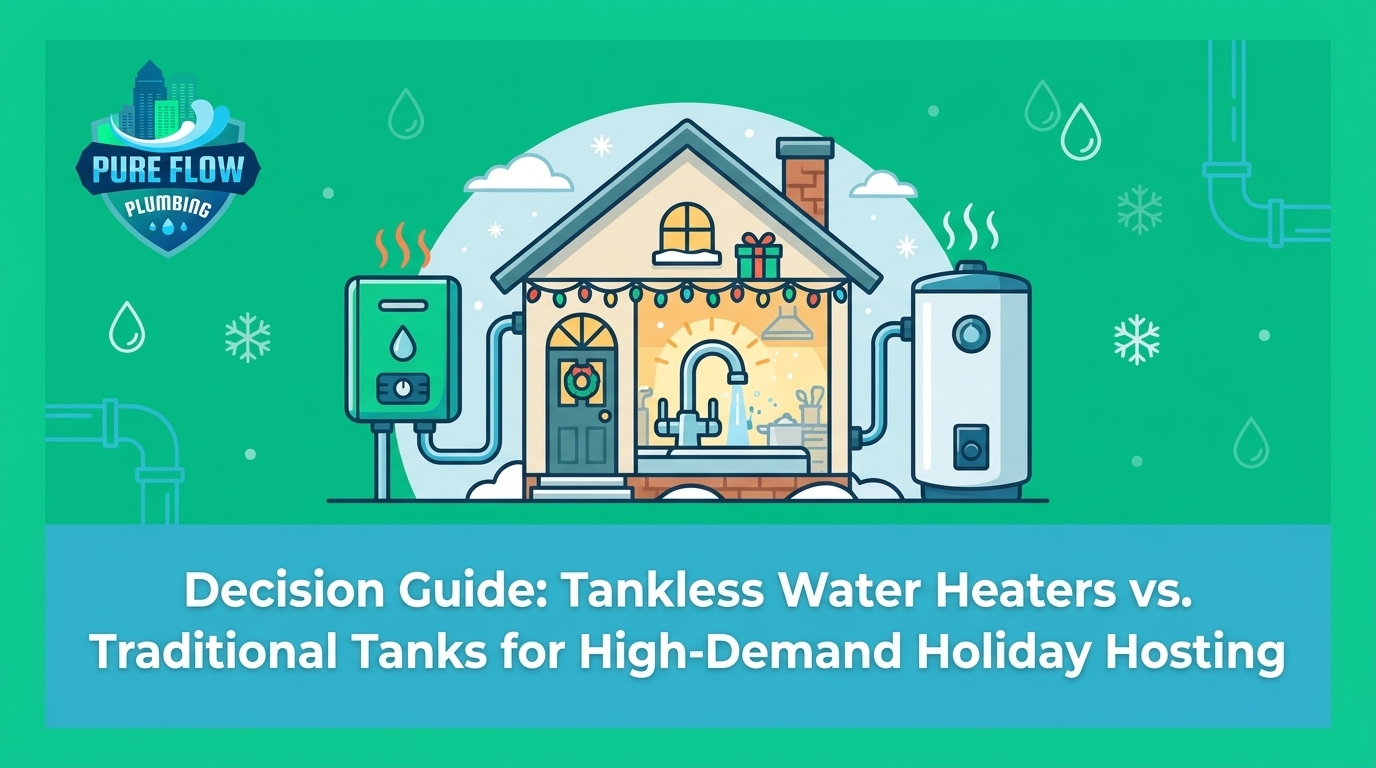
Will Your Hot Water Survive the Holiday Houseguest Invasion?
Are you prepared for the sudden spike in hot water demand when extended family arrives this year? At Pure Flow Plumbing, we field dozens of frantic calls every holiday season from York hosts whose systems just couldn’t keep up. Choosing between tankless water heaters vs. traditional tanks for high-demand holiday hosting is one of the most critical decisions you can make before the guest rooms fill up. Back-to-back morning showers can completely deplete standard systems, leaving your final guests shivering under an icy stream.
Evaluating the initial installation investment of a retrofit versus the peace of mind of reliable hot water is a necessary step for any host. The frustration of a cold shower surprise is stressful for both you and your visitors. September pre-holiday prep is the critical window to make this decision. By acting in the early fall, you secure your home’s hot water capacity well before winter emergency calls spike and plumbing schedules book up entirely.
The Anatomy of a Holiday Hosting Stress Test
Understanding what “high demand” actually means in a residential plumbing context is the first step to solving the problem. Everyday usage rarely pushes a plumbing system to its breaking point. However, holiday hosting creates a unique stress test that exposes the hidden limits of your equipment.
Here is how a typical holiday morning breaks down and why it strains your system:
- The Morning Shower Rush: According to EPA WaterSense data, the average shower uses 2.1 gallons of water per minute. When three or four people shower consecutively, they demand continuous, heavy output that standard equipment simply was not designed to handle.
- The Kitchen Catch-Up: While guests are showering, someone is usually in the kitchen preparing breakfast. Running the kitchen sink for food prep and starting a heavy dishwasher cycle adds another 1.5 to 2 gallons per minute to the total household demand.
- The Linen Turnover: Washing guest linens in warm or hot water cycles draws heavily on your hot water reserves, often right as the tank is trying to recover from the morning shower rush.
These simultaneous demands compound the strain on any system. When comparing high-capacity tankless vs. 50+ gallon traditional tanks, you have to shift your perspective. You are no longer just looking at baseline energy efficiency. You must evaluate peak-performance capabilities during extreme usage spikes to ensure your home can handle the holiday load.
Traditional 50+ Gallon Tanks: Capacity vs. Recovery Time
Standard traditional tanks operate on a simple principle: they heat a large volume of water and store it until you need it. While this works perfectly well for a standard family routine, it faces severe physical storage limits when 4 to 5 guests need to shower consecutively.
To understand how traditional tanks perform under the specific pressure of holiday guests, you have to look at the math. A 50-gallon tank supplying a 2.1 gallon-per-minute showerhead will run out of stored hot water in roughly 24 minutes of continuous use. That equates to just two moderately long showers before the tank is completely empty.
The Reality of Recovery Rates
Once a traditional tank is depleted, you are at the mercy of its recovery rate. The recovery rate is the amount of water the unit can heat to the set temperature in one hour. Depleted traditional tanks can take 40 to 50 minutes or more to fully recover. If your third guest steps into the shower 15 minutes after the second guest finishes, they will be greeted with lukewarm water that quickly turns freezing.
Pros and Cons of Traditional Tanks for Hosting
- Pro: Immediate flow. Because the water is already heated and stored, it delivers immediately to the fixture.
- Pro: Lower upfront investment. Replacing an old tank with a new 50+ gallon traditional tank generally requires less labor and fewer modifications to your home.
- Con: Hard storage limits. Once the 50 or 80 gallons are gone, the hot water completely stops until the recovery period finishes.
- Con: Standby heat loss. The system constantly consumes energy to keep 50+ gallons of water hot 24/7, even when your guest rooms are empty for nine months of the year.
- Con: Physical footprint. Upgrading to a massive 80-gallon tank to accommodate guests requires significant utility closet space that many homes simply do not have.
When weighing high-capacity tankless vs. 50+ gallon traditional tanks, the traditional model offers simplicity at the cost of a hard ceiling on your hot water supply.
High-Capacity Tankless Systems: Endless Flow vs. GPM Limits
Tankless systems operate on an entirely different philosophy. Instead of storing pre-heated water, they use powerful heat exchangers to instantly heat water as it flows through the unit. This fundamental difference requires a new way of thinking about your hot water supply.
The “endless hot water” concept is often misunderstood. It is true that a tankless system never runs out of hot water—it will keep heating water for as long as the tap is open. However, it is strictly limited by Gallons Per Minute (GPM). If you exceed the unit’s maximum GPM capacity, the water temperature will drop because the water is flowing too fast for the heat exchanger to warm it up properly.
Managing Simultaneous Demands
Multiple simultaneous fixtures will split the GPM output of a tankless unit. For example, if your tankless heater can produce 7 GPM, and you run two showers (2.1 GPM each) plus a dishwasher (1.5 GPM), you are drawing 5.7 GPM. The system will handle this easily. But if a fourth fixture opens—like a washing machine filling with hot water—you might hit the unit’s ceiling.
Because of this GPM limit, proper sizing is absolutely critical. You cannot simply buy the unit off the shelf and expect it to handle a busy holiday morning. You need a thorough professional assessment to ensure the unit matches your home’s peak simultaneous fixture demand. This is why securing professional water heater installation is non-negotiable for high-capacity upgrades. A licensed expert will calculate your exact fixture flow rates and recommend a high-capacity tankless vs. 50+ gallon traditional tanks based on real math, not guesswork.
How Winter Groundwater Temperatures Impact Performance
There is a hidden climate-specific variable that heavily influences water heater sizing and performance: groundwater temperature. The water entering your home from the municipal supply or well is not the same temperature year-round.
The Mechanics of Temperature Rise
The Problem: Water heaters operate based on “temperature rise.” This is the difference between the incoming cold groundwater temperature and your target 120-degree output at the showerhead. In the middle of summer, your incoming water might be a mild 70 degrees. The water heater only needs to raise the temperature by 50 degrees.
The Cause: As fall turns to winter, incoming groundwater gets significantly colder. In our years of serving York SC residential properties, the team at Pure Flow Plumbing has seen a common pattern where undersized systems fail during winter cold snaps. York groundwater temperatures drop noticeably in late fall and winter. If the incoming water is 45 degrees, your system suddenly has to achieve a 75-degree temperature rise.
The Solution: This massive increase in required temperature rise forces the water heater to work much harder. For tankless systems, a higher required temperature rise can temporarily reduce the maximum GPM flow rate. If the unit is forced to heat freezing water, it slows the flow down to ensure it reaches 120 degrees. If the system isn’t sized for York’s winter extremes, your water pressure will drop exactly when your holiday guests are trying to shower. Emphasizing community-tested sizing solutions ensures your unit is calibrated for local winter realities, not just national averages.
Retrofit Realities: Why Early Fall is the Ideal Upgrade Window
If you are tired of apologizing to houseguests for cold showers, you need to set realistic expectations for the installation process. Upgrading your system is a major home improvement project, and timing is everything.
We always advise our customers that September pre-holiday prep is the strategic pre-heating season window to complete retrofits. Once October and November arrive, our plumbing schedules at Pure Flow Plumbing become chaotic with emergency heating and frozen pipe calls. Booking your evaluation in September ensures the work is done, tested, and ready before the Thanksgiving turkey goes in the oven.
What a High-Capacity Retrofit Requires
Moving from a standard tank to a high-capacity system—especially a tankless unit—is rarely a simple swap. Common retrofit requirements include:
- Upgrading gas lines: High-capacity tankless units require a massive, sudden draw of fuel to instantly heat water. Your existing half-inch gas line may need to be upgraded to a three-quarter-inch line to deliver the necessary volume.
- Modifying venting systems: High-efficiency units produce different exhaust gases that require specialized PVC venting directly to the outside of the home, rather than using your old chimney flue.
- Electrical adjustments: Even gas-powered tankless units require a dedicated electrical outlet to power the internal computer board and sensors.
- Evaluating incentives: Generic federal tax credits may apply to qualifying high-efficiency installations. Always verify current programs with your utility provider or a tax professional to see if your upgrade qualifies for energy incentives.
Handling these modifications during the calm of early fall keeps the process smooth and stress-free.
Side-by-Side Comparison: Which System Wins for Holiday Hosting?
To make the best decision for your home, you need a definitive comparison framework. When evaluating high-capacity tankless vs. 50+ gallon traditional tanks, the right choice depends heavily on your hosting style and your home’s infrastructure.
| Feature | Traditional 50+ Gallon Tank | High-Capacity Tankless System |
|---|---|---|
| Upfront Installation Investment | Generally lower; utilizes existing venting and gas lines in most cases. | Higher initial investment; often requires gas line and venting retrofits. |
| Back-to-Back Shower Performance | Strictly limited by tank size. Runs out after 2-3 consecutive showers. | Endless hot water. Limited only by simultaneous GPM draw. |
| Recovery Time | 40 to 50 minutes to reheat a depleted tank. | Instantaneous heat; zero recovery time required. |
| Space Requirements | Requires a large, dedicated footprint in a utility closet or garage. | Wall-mounted, compact design frees up significant floor space. |
| Maintenance Needs | Requires annual flushing to remove sediment buildup from the tank bottom. | Requires annual descaling to keep the delicate heat exchanger clear of minerals. |
| Best Suited For… | Homes with ample space, smaller budgets, and infrequent large gatherings. | Frequent hosts who prioritize endless hot water and long-term efficiency. |
If your primary goal is to ensure five guests can shower one after the other without a drop in temperature, a properly sized high-capacity tankless system is the clear winner. However, if your home cannot accommodate the necessary gas line upgrades, a larger traditional tank may be the most practical compromise.

Frequently Asked Questions About High-Demand Water Heating
Will a tankless water heater run out of hot water with guests?
No, a tankless water heater will never run out of hot water because it heats water continuously as it flows. However, if too many guests turn on fixtures at the exact same time, the system may struggle to keep up with the volume demand. As long as fixtures are used somewhat sequentially, the hot water is truly endless. Comparing high-capacity tankless vs. 50+ gallon traditional tanks shows that tankless is vastly superior for back-to-back usage.
How many showers can a tankless water heater handle at once?
A properly sized, high-capacity tankless unit can typically handle two to three simultaneous showers. This depends entirely on the unit’s maximum Gallons Per Minute (GPM) rating and the flow rate of your showerheads. If your unit is rated for 7 GPM and your showerheads use 2 GPM, you can safely run three showers at once. A professional assessment is required to calculate your exact capacity.
Can traditional water heaters keep up with a large family?
Traditional water heaters can struggle to keep up with a large family during peak morning routines. A standard 50-gallon tank will generally provide enough hot water for two to three showers before it needs 40 to 50 minutes to recover. If a large family spaces out their showers between morning and evening, a traditional tank works fine, but clustered usage will lead to cold water.
Why does my hot water run out faster in the winter?
Your hot water runs out faster in the winter because the incoming groundwater is significantly colder. Your water heater has to work much harder to raise freezing winter water up to your desired 120-degree output. This increased “temperature rise” depletes traditional tanks faster and can slightly reduce the flow rate of tankless systems during extreme cold snaps.
How do you size a tankless water heater for multiple showers?
You size a tankless water heater by calculating your household’s peak simultaneous demand in Gallons Per Minute (GPM). You add up the flow rates of all the fixtures you might realistically run at the exact same time (e.g., two showers and a dishwasher). You then cross-reference that total GPM with your region’s winter groundwater temperatures to find a unit that can handle the required temperature rise.
What are the ventilation requirements when upgrading to a larger system?
Upgrading to a high-capacity, high-efficiency water heater usually requires changing your ventilation from a standard metal chimney flue to dedicated PVC piping. These modern units extract so much heat during the combustion process that the exhaust gases are cool enough to be vented through PVC directly out the side of your home. This ensures safe operation and prevents acidic condensation from damaging your masonry.
Secure Your Home’s Hot Water Supply Before the Holidays Arrive
A clear, practical framework gives you the confidence to choose the right retrofit before the holiday season begins. You do not have to cross your fingers and hope the hot water lasts this year. By understanding the true demands of your household and how different systems respond to extreme usage spikes, you can make an informed, stress-free upgrade.
Use this September pre-holiday prep window to schedule a comprehensive evaluation of your plumbing system. Consult with our local experts at Pure Flow Plumbing to weigh your specific household options, assess your gas and venting infrastructure, and calculate your exact GPM needs. Secure your home’s hot water supply today, and enjoy the peace of mind that comes with knowing every guest will enjoy a warm, comfortable stay.